Angle Type Challenge: Identify Angles From Diagrams or Degrees
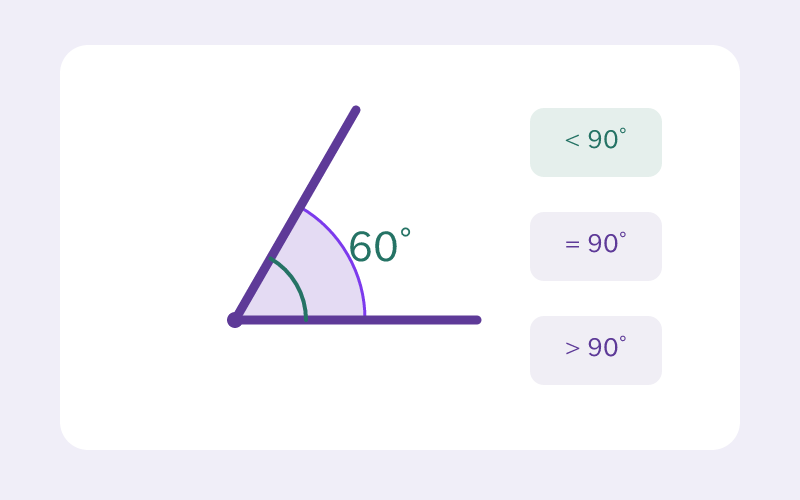
Look at the marked turn, choose its angle type, and use the explanation to check your reasoning.
Name the Turn, Even When the Rays Rotate
Angle Type Challenge is a ten-question single-player activity. Choose a diagram round or a round using degrees. The basic set covers acute, right, obtuse and straight angles; the extended set also includes reflex angles. In diagram mode, the shaded arc identifies the turn to classify. Rotating both rays changes how the picture looks, but not the size of the angle. Each answer is recorded once, followed by an explanation before you move to the next question.
Build Angle Vocabulary Before Measuring
The basic round supports identifying acute, right and obtuse angles, with straight angles as a benchmark. The extended round adds reflex angles. This is classification practice for learners familiar with angle vocabulary; it is not a protractor measurement task. Use the site’s Angle Dial or Angle Measure Lab for a different kind of angle practice.
Compare Angles With 90° and 180°
- Acute angles are greater than 0° and less than 90°.
- A right angle is 90°; an obtuse angle is greater than 90° and less than 180°.
- A straight angle is 180°; a reflex angle is greater than 180° and less than 360°.
How to Play the Angle Identification Game
- Choose the basic or extended angle set, then diagrams or degrees.
- Read the marked angle and select its type. There is no countdown.
- Read the explanation and select Next. Finish ten questions to review your result, then start a new round.
Ask What Stays the Same When an Angle Turns
Start with the basic set. Ask students to explain their choice using 90° or 180°, then compare differently oriented examples. Introduce reflex angles only after students can identify which arc the question marks. Review missed types after the round.
Angle Type Game Questions
Q: Which types of angles can I practice?
A: The basic set includes acute, right, obtuse and straight angles. The extended set adds reflex angles.
Q: Do I read a diagram or a number of degrees?
A: You choose either diagrams or degrees before starting. In a diagram, classify the turn marked by the shaded arc.
Q: Is the game timed?
A: No. Each round has ten questions, and you choose when to continue after reading the explanation.
Q: Can I use a keyboard or a touchscreen?
A: Yes. Tap an answer, or use the keyboard to focus an answer button and activate it with Enter or Space.