Polygon Total Puzzle: Balance Every Polygon Edge to Its Target Sum
Square and pentagon tasks generate fresh number pools and common side sums.
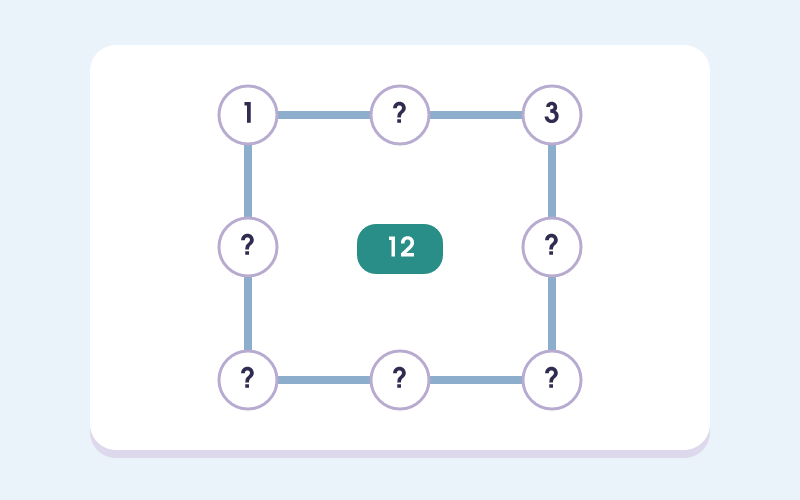
| Name | Polygon Total Puzzle |
|---|---|
| Catalog grade suggestions | Grade 4, Grade 5, Grade 6 |
| Actual task | Fill square and pentagon nodes so each edge sums to the target |
| Practice objective | Practice the following task: Fill square and pentagon nodes so each edge sums to the target |
| Optional curriculum references | CCSS.MATH.CONTENT.4.OA.A.3 (Common Core State Standards); CCSS.MATH.CONTENT.4.NBT.B.4 (Common Core State Standards); CCSS.MATH.CONTENT.6.EE.B.5 (Common Core State Standards) |
Grades are catalog suggestions. Curriculum entries are references, not certification. Choose a practice length that fits your session.
A Shared Corner Ties Two Edges Together, So No Side Solves Alone
Square and pentagon tasks generate fresh number pools and common side sums. Place all numbers so every edge meets the target; New set changes the data and retry retains the current level.
Why Missing-Addend Fluency Grows Into Reasoning About Linked Equations
Polygon Total Puzzle builds on the missing-addend fluency of Grade 4, where students find what a total still needs (4.OA.A.3, 4.NBT.B.4). Here each edge is a small equation, and the shared corners turn several of those equations into one connected system to satisfy at once. That linkage is the bridge into Grade 6 work on writing and reasoning about equations with an unknown (6.EE.B.5), where a single value must make more than one condition true.
Three Skills Practiced in Polygon Total Puzzle
- calculating target sums across several edges
- tracking linked constraints at shared nodes
- choosing the adjustment with the widest effect
Teacher and Parent Note
Start with the edge furthest from its target, then identify which of its nodes also belongs to another edge. Require a full-shape check after each move instead of checking only the side that changed.