Equal Fraction Bars: Shade Bars Until Equal Fractions Line Up
Fill a fraction bar to match the value of a reference bar. Different numbers of equal parts can represent the same amount of a whole.
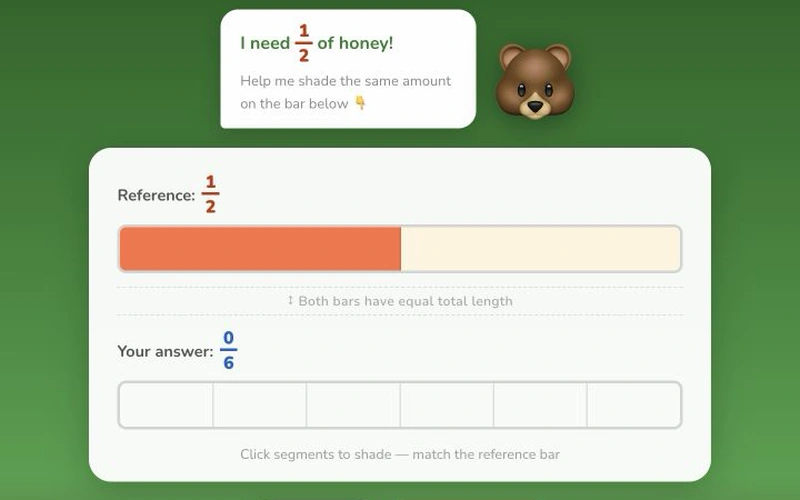
| Name | Equal Fraction Bars |
|---|---|
| Catalog grade suggestions | Grade 3, Grade 4, Grade 5 |
| Actual task | Color fraction bars to explore equivalent fractions visually |
| Practice objective | Practice the following task: Color fraction bars to explore equivalent fractions visually |
| Optional curriculum references | CCSS.MATH.CONTENT.3.NF.A.1 (Common Core State Standards); CCSS.MATH.CONTENT.3.NF.A.3 (Common Core State Standards); CCSS.MATH.CONTENT.4.NF.A.1 (Common Core State Standards) |
Grades are catalog suggestions. Curriculum entries are references, not certification. Choose a practice length that fits your session.
Why can different fractions have the same value?
Equivalent fractions represent the same amount of the same whole. Equal Fraction Bars lets you compare a reference bar with the bar you fill and check whether that amount stays the same.
Worked example: for the same-size whole, 1/2 = 2/4. The number of parts changes while the shaded amount stays the same.
| Controls | Select bar segments to shade |
|---|---|
| Comparison condition | The same-size whole |
| Task | Represent equivalence; not an unrestricted calculator |
Same Whole, Different Slices: Why 2/4 and 1/2 Stop Looking Different
Practice freshly generated equivalent fractions and use fraction bars to compare different numerators and denominators representing the same area. A new run changes the values; clearing keeps the current task.
Grades 3-5: Building Equivalence Before Common Denominators
Equal Fraction Bars sits right after students first meet a fraction as part of a whole (CCSS 3.NF.A.1) and drives the equivalence reasoning of 3.NF.A.3, where visual models justify why 1/2 and 2/4 name the same amount. Mastering the shaded-length comparison here is the groundwork for 4.NF.A.1's more formal equivalence and, later, the common denominators that rational-number arithmetic requires.
Three Fraction Muscles Trained While Coloring Forest Bars
- Align the full fraction bar first: students check that the whole stays the same before judging numerator or denominator size, which protects Number Sense.
- Shade the matching colored blocks: 1/2, 2/4, and 3/6 become visible lengths, building Conceptual Understanding of equivalent fractions.
- Compare two forest rows side by side: students connect visual length with symbolic fraction language before moving toward fraction Fluency on paper.
Three Moves Through the Forest: Read, Shade, Compare
- Read the target fraction and look at how many equal parts the forest bar has.
- Click or tap the colored blocks that match the numerator while keeping the same whole in view.
- Submit the model and compare the feedback. Equal shaded lengths show equivalence; mismatched lengths send students back to the whole.
- Teacher tip: ask students to say why two bars match before loading the next round.
Five-Minute Teacher Routine: Turn Two Forest Bars Into Talk
After one round, pause before the next problem. Have students draw two equal-length bars, split one into 2 parts and one into 4 parts, then shade 1/2 and 2/4. The check is the explanation: if they can say why the shaded lengths match, the equivalent-fraction idea is ready to travel beyond the screen.
Equal Fraction Bars Questions Teachers Hear During Bar-Model Lessons
Q: What does Equal Fraction Bars ask students to do?
A: Students shade segments on a bar to match a target fraction and compare the shaded length with a reference bar.
Q: Why must the two fraction bars have the same whole?
A: Equivalent fractions describe the same amount of an equally sized whole. Changing the whole would change the comparison.
Q: Is Equal Fraction Bars a fraction calculator?
A: No. It is a visual equivalence activity. Students represent a fraction and explain why two shaded lengths match.
Q: How can a teacher use it as a math center?
A: After a short lesson on equal wholes, ask students to record one pair such as 1/2 and 2/4 and write one sentence explaining the matching bar lengths.