Make Twenty Pairs: Pair Every Bubble Into a Complete 20
Ten numbered bubbles float on screen; grab one, hunt down the partner that completes 20, and clear all five pairs before the timer runs out. Each match rebuilds 20 as a whole made of two known parts.
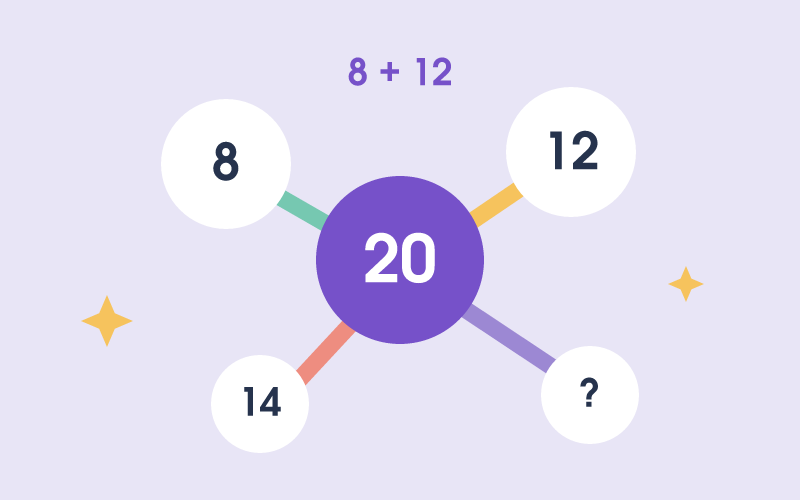
| Name | Make Twenty Pairs |
|---|---|
| Catalog grade suggestions | Grade 1, Grade 2 |
| Actual task | Find pairs totaling 20 in a timed matching activity. |
| Practice objective | Practice the following task: Find pairs totaling 20 in a timed matching activity. |
Grades are catalog suggestions. Curriculum entries are references, not certification. Choose a practice length that fits your session.
Task and scope
Most first graders can find 13 + 7, but only by counting 14, 15, 16 all the way up — so 20 never settles into a fixed shape in their heads. This game stalls that habit on purpose: the moment you hold the 13 bubble, the only useful question becomes "how far to 20?", not "what comes next?". Because both cards snap into a shared 20-frame the instant they pair, the missing 7 stops being a counting result and becomes a remembered partner. Over a 60-second round the same friends — 11 with 9, 12 with 8, 13 with 7 — surface again and again until the decomposition is automatic. That repetition is what turns a slow count into instant recall of the bond.
Check readiness and task range
Choose for complements to 20 after learners can work with the target sum. The configured countdown is 60 seconds.
Practice in this activity
- Calculate the complement: subtract the first bubble’s value from 20.
- Distinguish values from bubbles: equal values still need two different bubbles.
- Check the sum: after an incorrect choice, add the two values again before selecting another pair.
Controls and steps
- Select a numbered bubble and work out how much it needs to reach 20.
- Click a different bubble to form a pair. A correct match clears; after an incorrect match, wait for the red feedback to end and choose again.
- Find all five pairs within 60 seconds. Review the pair count at the end and choose Play again to restart.
Teaching discussion
Compare a pair such as 13 and 7 with 10 and 10. Ask how the learner checked the total rather than only counting cleared bubbles.
Questions about the task
Q: Is Make Twenty Pairs a place-value exercise?
A: Its direct task is finding two values with a sum of 20. It does not ask students to construct base-ten blocks.